SERVICE REQUEST?
Fill out the form below.
Find our nearest location
Your Local Office

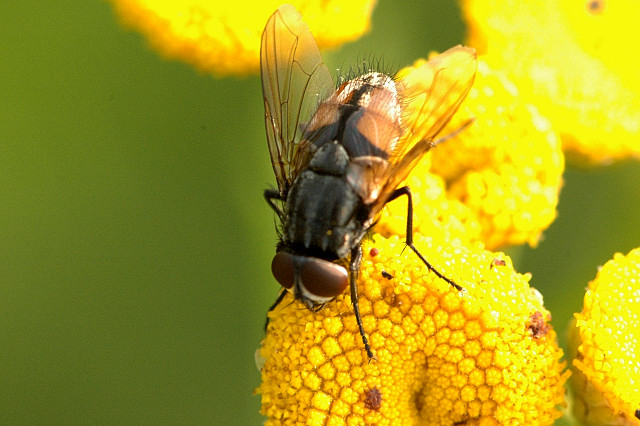
Face Fly
Attribution: James Lindsey at Ecology of Commanster [CC-BY-SA-2.5 or CC-BY-SA-3.0], via Wikimedia Commons
Size:
Medium-sized flies about 1/4-inch in length.
Color:
Dark gray; four stripes are present on top of the thorax in front of the wings. Looks identical to a house fly.
Behavior:
This fly is very closely related to the house fly and, in fact, an entomologist is needed to distinguish between the two species. If “house flies” are suddenly appearing inside a building during the fall, winter, or spring, then face flies are likely involved. The face flies status as a pest is similar to that of the cluster fly. These flies have discovered that heated buildings are ideal for surviving the cold of winter, and the face fly is one such species. As the weather cools in late summer and early fall, the sun warms the southern and western walls of buildings. The warmth attracts these insects to buildings where they crawl inside cracks and stay there for the winter. This would be fine, but during warm winter days, some flies “wake up” and end up on the inside of the building.
Like house flies, face flies breed primarily in fresh animal manure and so are more common in buildings in rural areas near farms.
The best way to control face flies is by prevention as described below. If it’s too late and they are already inside, it takes a professional to find and treat the right areas to minimize the numbers of pests seen inside. If your building has experienced a problem in the past with face flies (or other overwintering pest species), take the following steps next summer to prevent a recurrence:
- Seal as many cracks and holes on the outside of the building as possible, especially on the south and west walls where the sun heats the surfaces during the late summer and fall.
- Be sure that all foundation and attic vents (if present) have tight-fitting insect screens. Plug weep holes in brick veneer buildings with small pieces of screening or wire mesh. Do not permanently seal weep holes.
- Check the soffit vents and any gable vents or turbine vents on the roof.
- Have your Terminix professional treat the outside west and south walls of the building near the eaves. This treatment should be completed in mid- to late August.
Family Name:
Musca autumnalis
Read What Our Clients
Are Saying
Ronaldo (Thomas) was amazing! He goes above and beyond ever service!

Zach H is the bomb! Great customer service! Handle my problem superior. I was freaking out I’m terrified of mice/rats and Zach made me comfortable and confident that Terminix will get the job done over all the other pest companies call “Zach Attack at Teminix!”👍🏾
Super friendly and dedicated to quality customer service!
Very satisfied with their service.
Incredible customer service. Thorough and professional!
Explained in detail and was very professional with everything he done
Quenton, is a great technician did a thorough job.
Ronaldo provides exceptional service. I recommend his customer service
Service has been excellent and our technician is curtesy and informative. Any requests we have made are taken care of.
Ronaldo Thomas did a great job. Thank you sir for taking your time and not rushing great service
Mr. Thomas was amazing! He explained everything that he was doing and was very nice.
Service was Excellent! My Technician Andrew Patrick was on time and very efficient. Very courteous and knowledgeable.I would definitely Recommend Terminix and Andrew to Neighbors and Friends He is Always a Pleasure…
SERVICE REQUEST?
Fill out the form below.